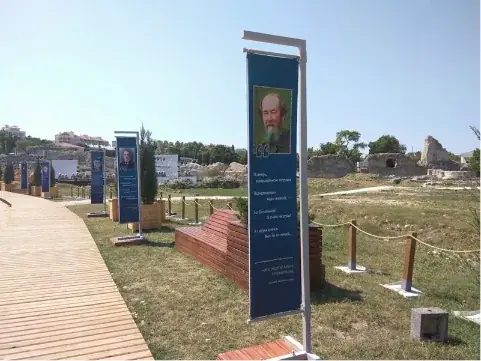
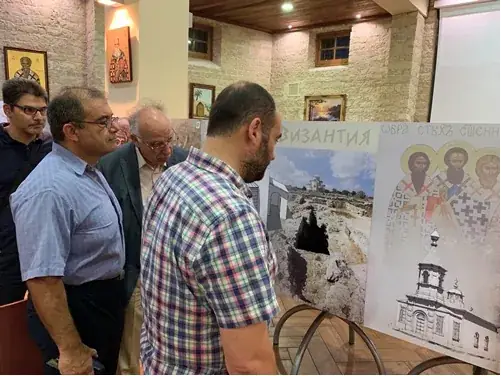
In June 2019 the cathedral in the Cypriot city of Limassol hosted a stand exhibition, “Treasures of Chersonesus”. It showed Christian relics found during excavations at the Crimean museum-reserve “Tauric Chersonesus”.
As the organisers noted, the exhibition, blessed by Metropolitan Lazar of Simferopol and Crimea, aroused “huge interest among both Cypriots and our compatriots”.
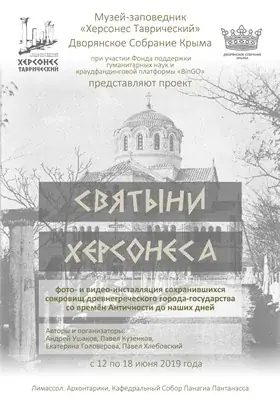
At first glance this exhibition was just a modest cultural event of a purely museum nature, though a legally dubious one. Under international law, the “Tauric Chersonesus” museum-reserve, which is on the UNESCO World Heritage list and is located in Russian-occupied Crimea, still belongs to Ukraine. As a result, since 2016 UNESCO has stopped monitoring the condition of the museum-reserve.
This display, organised by Russia, was in essence an exhibition of “trophy art” that Russia had illegally appropriated. However, it was a stand exhibition, which means only images of the exhibits were shown. That removed the risk of their seizure if Ukraine brought legal claims.
This alone gives grounds to suspect that the exhibition is not so simple. A closer look at the organisation and organisers of the event reveals a long-running political intrigue involving various pseudo-public organisations, Russian government bodies, Orthodox hierarchs and the Russian security services, which play a key role in this operation.
The organisers
The main organiser of the exhibition was Andrei Konstantinovich Ushakov: official representative of the Russian Nobility Assembly in the Republic of Cyprus, leader of the Nobility Assembly of Crimea (NAC), director of the “Cultural Heritage of Crimea” foundation for cultural and educational programmes, and initiator of the “Club of Friends of Tauric Chersonesus”.
The exhibition was also organised with the participation of the Foundation for the Support of the Humanities and the state museum-reserve “Tauric Chersonesus” near Sevastopol.
A short digression is needed here.
Immediately after the collapse of the USSR, countless front “scientific”, “public” and “charitable” organisations began to appear in Russia, most of them with a KGB lining. They handed out their own “public” orders and titles in Russia and abroad, holding ceremonial receptions for this purpose, often under the auspices of Russian embassies, consulates and cultural centres.
At one time I counted more than fifty such “academies” alone in Russia. Most of them were active internationally.
On the one hand, these bodies feed on vain and ignorant people who buy from them comic “public” orders and titles of nobles, academicians, professors, doctors, colonels and generals. On the other hand, they function as branches of the security services.
They hold international events where they hand out their awards to the right people, preparing contacts and recruitment in this way. They are also most often run by people from the security services. As a rule, such outfits have vague sources of funding (which in itself makes things clear) and very lavish and pretentious stated goals.
The Russian Nobility Assembly (RNA) undoubtedly belongs to the same category of front government outfits imitating public activity. Its website says:
“In its activities the Russian Nobility Assembly pursues cultural and educational goals aimed at reviving the greatness of Russia, …the Faith of our ancestors and the historical traditions of Russian statehood… At establishing true culture in Russia…. Traditions of faithful service to the Fatherland… high morality and spirituality.”
This is the meaningless, chauvinist and anti-democratic vocabulary typical of state security, which rather poorly disguises the traditional tasks of the Soviet and Russian security services.
The Russian Nobility Assembly consists of 51 regional branches in Russia and 13 branches and representative offices abroad.
The Nobility Assembly of Crimea was set up as a regional branch of the RNA after the occupation of the peninsula in 2015 and registered in early 2016. From the very start its leader was Andrei Ushakov, a man with a rather curious biography.
According to information on the NAC website, Andrei Konstantinovich Ushakov was born in Moscow and studied at the physics faculty of Moscow State University in 1989-1994. But already from 1995 he headed the “Commonwealth Expert Information Service” group of companies, which acted as the secretariat of the “Russian Olympus” award.
This strange outfit organised programmes called “Russian Construction Olympus”, “Reliable Organisations of the Construction Complex”, “Russian Energy Olympus” and “Russian Financial Olympus”. The programmes selected “enterprises and companies holding leading positions in sectors of the economy. In a solemn atmosphere the laureates receive public awards testifying to their high professional competence.”
In 2005 Ushakov held an international forum in Cyprus with the telling title “Investment Attractiveness of Russia’s Regions”, accompanied by the handing out of “Russian Olympuses”. In the same year the programmes “Ukrainian National Olympus”, “Ukrainian Financial Olympus” and “Ukrainian Construction Olympus” were organised.
In 2009 the “Russian Olympus” programme in the financial sector got a new name, “Golden Phoenix”. In 2011 this “group of companies” organised a conference in Geneva with the exotic title “Experience and History of Self-Regulation in Western European Countries”. At the same time the 15th anniversary of the “Russian Olympus” award was celebrated there and its laureates were honoured.
According to Andrei Ushakov himself, he worked and lived in Cyprus and in Switzerland. In 2014, after the annexation, he returned to Crimea, as he says, “in connection with the reunification of new regions with Russia, the Republic of Crimea and the city of Sevastopol”. Since Russia seized Crimea, Ushakov has served in Crimea, where he set up yet another organisation with an exotic name, the “Unified Expert Information Centre of Crimea and the City of Sevastopol”.
In 2015, when the Crimean branch of the Russian Nobility Assembly was created, Ushakov was elected leader of the Crimean nobility.
On his initiative the “Cultural Heritage of Crimea” foundation for cultural and educational programmes was also set up. Its goal is the restoration of cultural heritage sites on the Crimean peninsula and the development of culture and art.
“With funds from the ‘Cultural Heritage of Crimea’ foundation, a number of internationally significant events were held in 2016-2019 that helped strengthen the positive image of Crimea and objective information about the legality and historical justification of its return to Russia.”
The last sentence reveals the real goal of the foundation’s work, which is KGB-style propaganda. Ushakov’s work record lacks even a hint of any formal professional affiliation and at first glance looks completely absurd. At second glance it reveals many years of work by an undercover security service officer focused on foreign countries. In this sense it is typical.
The other organiser of the exhibition, the “My History” Foundation for the Support of the Humanities, was registered in Moscow in May 2014, two months after the annexation of Crimea and most likely in connection with it. It is a non-profit organisation set up “to implement programmes supporting projects in the cultural and educational spheres”. The foundation’s main object of care is Tauric Chersonesus.
Its partners include the Presidential Grants Foundation, Gazprom, the Moscow Patriarchate, the Russian ministries of education and culture and the governments of various Russian cities. In other words, the foundation is openly governmental.
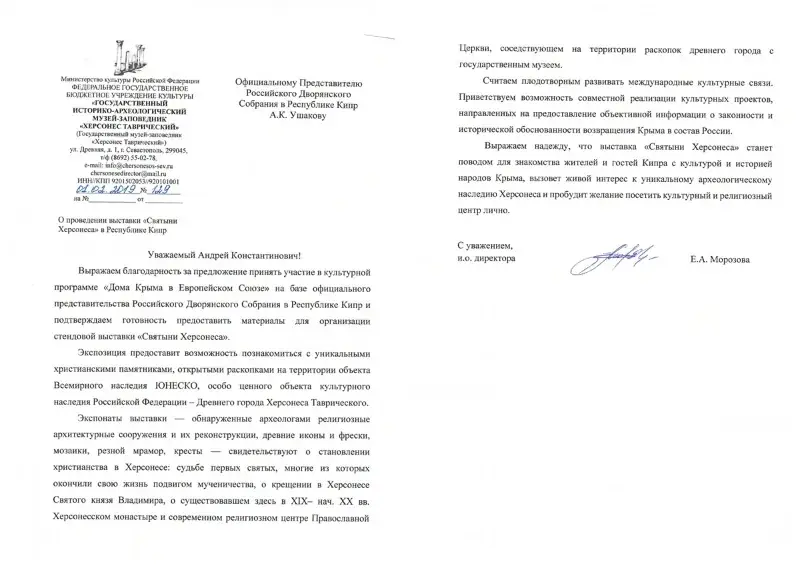
The main goal of the exhibition in Cyprus was stated quite unambiguously in a letter of 1 February 2019 from E.A. Morozova, acting director of the “Tauric Chersonesus” museum-reserve, to Andrei Ushakov, official representative of the Russian Nobility Assembly in Cyprus:
“We welcome the opportunity to jointly implement cultural projects aimed at providing objective information about the legality and historical justification of Crimea’s return to Russia.”
The Crimea House in the European Union and the friends’ club
According to plans published on the NAC website, the exhibition in Cyprus was supposed to take place back in January 2019. More precisely, in January a cultural centre, the “Crimea House in the EU”, was to open in Cyprus, and its activity would have started with the exhibition.
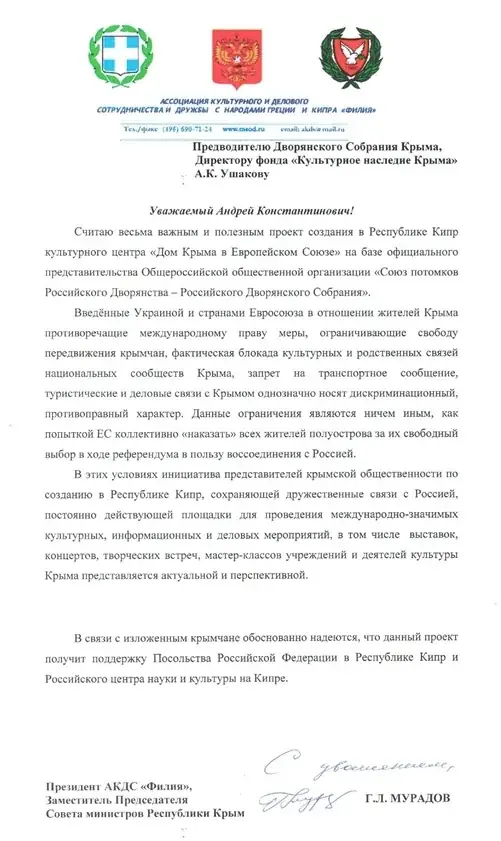
The reasons for creating the “Crimea House in the EU” are set out in detail in a letter from G.L. Muradov, Deputy Chairman of the Council of Ministers of the Republic of Crimea, to the same Ushakov.
“The measures introduced by Ukraine and the EU countries against residents of Crimea, which contradict international law, restrict the freedom of movement of Crimeans, amount to an actual blockade of the cultural and family ties of the national communities of Crimea, ban transport links, tourist and business ties with Crimea, and are clearly discriminatory and unlawful. <…>
In these conditions, the initiative of representatives of the Crimean public to create in the Republic of Cyprus, which maintains friendly ties with Russia, a permanent venue for internationally significant cultural, information and business events, including exhibitions, concerts, creative meetings and master classes by Crimean cultural institutions and figures, seems relevant and promising.”
This letter actually outlines the goal of the whole operation. The aim was to break through the European Union and force at least one of its members to recognise Russia’s annexation of Crimea, if not legally, then indirectly.
The cultural, historical and religious aura around the activities of the leader of the Crimean nobility in Cyprus was only a disguise. This was not about Christian relics at all.
“The ‘Crimea House in the European Union’ will open in January 2019 with the exhibition ‘Treasures of Chersonesus’, created specially for this event by our old friends and partners, the ‘Tauric Chersonesus’ museum-reserve,” says the section “Crimea House in the EU” on the NAC website.
The authors and organisers of the exhibition hoped it would become “a good Christmas present for residents and guests of Cyprus, arouse interest in the unique archaeological heritage of Chersonesus and awaken a desire to visit the cultural and religious centre in person”.
In addition, the explanatory note to the project says that the “Crimea House in the EU” is being created on the basis of the official representative office of the Russian Nobility Assembly in Cyprus,
“where internationally significant cultural and business events contributing to the strengthening of the positive image of Crimea will be held on a permanent basis.”
“The ‘Crimea House in the European Union’ will undoubtedly become a place where citizens of other countries meet the culture of the peoples of Crimea, a place to get acquainted with the main spiritual, historical and tourist sites of the peninsula. For this purpose, exhibitions, concerts, creative meetings and master classes of cultural institutions and figures of the Republic of Crimea and the city of Sevastopol are planned on a permanent basis at the new office. We have already engaged with a number of Russian and international organisations about the creation of the ‘Crimea House in the European Union’ and have received a positive response everywhere,” the description says.
The plans for the proposed cultural centre in Cyprus were announced as grandiose: in January the exhibition “Treasures of Chersonesus”, in February-April a multimedia exhibition “Crimea in the Destiny of Russia” shown daily in Russian, Greek and English. Weekly multimedia exhibitions about outstanding people connected with the Crimean peninsula were also planned.
A visit to the “Crimea House in the EU” by the well-known traveller and priest Fyodor Konyukhov was announced, as well as concert programmes “Crimea in the Musical Art of Russia” with Crimean musicians, dancers, opera and ballet artists.
Round tables and conferences on various topical issues were planned throughout 2019. It was also announced that the work of the “Crimea House in the EU” in Cyprus would lead to the creation of a “Club of Friends of Crimea”.
The Club of Friends of Crimea
As part of the ambitious idea of the “Crimea House in the EU”, an international project, the “Club of Friends of Crimea”, was to appear in Cyprus, “which will include compatriots living abroad, Russian and foreign citizens who share an interest in the Crimean peninsula”. Return events on the Crimean peninsula with members of the “Club of Friends of Crimea”, which would help with “financing joint programmes”, were also planned, the Nobility Assembly website says.
However, at some point the future “Club of Friends of Crimea” was prudently renamed the “Club of Friends of Tauric Chersonesus”.
The organisers invited international and Russian companies, charitable foundations and private individuals to take part in the club’s activities.
In an interview with a Russian-language Cypriot portal, Ushakov explained the reasons for registering the “Club of Friends” precisely in Cyprus:
“We decided to register it there because if it were registered in Sevastopol it could not be international because of the sanctions, and the whole point of the association would be lost. It will be supported from the private funds of patrons.”
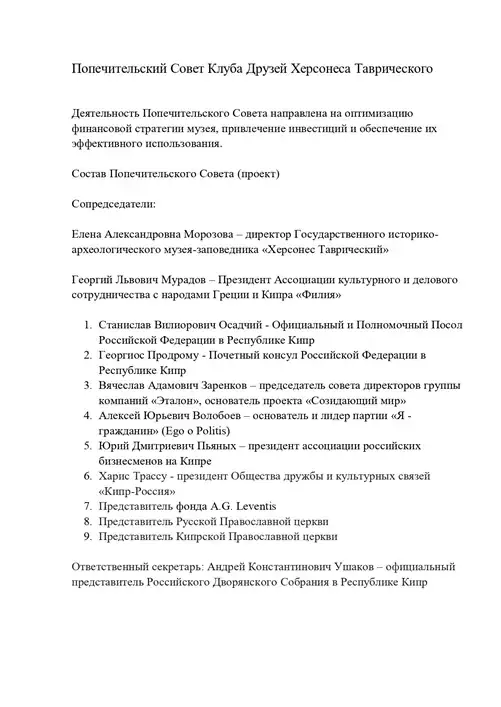
In the same interview Andrei Ushakov said that “a draft list of members of the club’s board of trustees has been prepared”, whose work is aimed at optimising the museum’s financial strategy, attracting investment and ensuring its effective use.
In other words, the idea was that international companies, charitable foundations and private individuals would, via Cyprus, attract investment and optimise the financial strategy of a Ukrainian museum that, after the annexation of Crimea and its transfer into Russian ownership, received Russian state funding.
The planned membership of the board of trustees of the “Club of Friends of Crimea” in Cyprus turned out to be very curious.
MGIMO graduate Georgy Muradov was Russia’s ambassador to Cyprus in 1996-1999. He headed the international relations department of the Moscow government. From 2010 to 2014 he was deputy head of Rossotrudnichestvo.
The full name of this government body is the “Federal Agency for the Commonwealth of Independent States, Compatriots Living Abroad and International Humanitarian Cooperation”.
Rossotrudnichestvo was created in 2008, but it is the successor of the All-Union Society for Cultural Relations with Foreign Countries (VOKS), which existed until 1958 and then changed its name several more times. In the USSR, ties with foreign countries were traditionally the responsibility of state security, starting with the Foreign Department of the OGPU in the 1920s. This did not change in post-Soviet times, so Rossotrudnichestvo can safely be considered a departmental offshoot of the FSB.
Muradov sits on the presidium of the Russian government commission on compatriots abroad and of the international council of Russian compatriots. Since 2014 he has been under EU sanctions for actions undermining the territorial integrity of Ukraine.
Muradov is active as president of the “Philia” association and also holds regular events at the Cypriot embassy in Moscow.
The list of proposed trustees of the “Club of Friends” also included Russia’s ambassador to Cyprus Stanislav Osadchiy, Russia’s honorary consul in Cyprus Georgios Prodromou, the Orthodox businessman Vyacheslav Zarenkov, Alexei Voloboev, founder of the “Russian party” in Cyprus “Ego o Politis”, and other well-known people.
According to available information, Alexei Voloboev supported the project on the ground and handled “public relations” in Cyprus.
The party with the resounding name “Ego o Politis” (I am a citizen) was created in autumn 2017. Its official goal is stated very vaguely: “to unite citizens of Cyprus with modern views into a single political party”.
In reality the party consists only of a leadership group, fully controlled from Moscow. There are no ordinary members. The leadership includes Russian-speaking citizens from former Soviet countries living in Cyprus and Greek Cypriots with Russian ties or education. The current party president, who plays a purely decorative role, is Yiorgos Kounturis, a Greek Cypriot conductor who studied in Russia.
Now the party avoids any reference to its Russian roots and imitates a normal Cypriot party. Its main task is to rely on Russian emigrants with Cypriot citizenship and on Pontic Greeks who once emigrated from the USSR, get its candidates into the local parliament, start influencing Cypriot policy and the presidential election and, ideally, pull Cyprus out of the European Union.
After the “failure” of the operation, the party functionary Voloboev, for obvious reasons, tried in every way to distance himself both from the list of trustees and from the project as a whole. He claimed he had nothing to do with it, did not know how he got on the list of trustees, that it was some kind of provocation, and that he did not know Andrei Ushakov. However, the editors have evidence of the connection between these people.
So one can conclude that the Board of Trustees of the “Club of Friends of Crimea” in Cyprus was to consist of Russian officials, Cypriot “friends of Russia” imitating independent public and political activity, and agents of the Russian security services disguised as representatives of both groups.
“Trojan horses” and the treasures of Chersonesus
Still, this grandiose project was not destined to be carried out in full. At some stage, after the “Crimea House in the EU” project was renamed the “Club of Friends of Tauric Chersonesus”, it was reworked and heavily reduced. The exhibition was moved to June 2019. The Crimean artists, films, multimedia exhibitions and “round tables” never reached Cyprus.
On the eve of the “Treasures of Chersonesus” exhibition, information about the “Crimea House in the EU” project leaked to the Cypriot press, where it was called an operation of the Russian security services.
In the Cypriot publication Cyprus Mail, the former Ukrainian ambassador to Cyprus Borys Humeniuk responded to the leak about the project. In the article “Russia’s Crimean ‘Trojan horse’ in Cyprus” he called Moscow’s efforts to prove that Crimea one way or another belongs to Russia “clumsy”.
“This action is aimed at promoting in Cyprus the idea that the occupied territory of Crimea is territory of the Russian Federation, and at creating a foothold on the island to represent the peninsula’s interests in humanitarian matters. Cyprus will never officially approve the opening of such a ‘representation’ in the republic, and so Russia resorts to insidious methods to achieve its goal. Moscow often promotes its specific interests in the EU through Cyprus, using the religious and cultural ties between the two countries that have developed over the years.”
Although the Russian press claimed that the Crimean exhibition aroused “huge interest”, public attendance turned out to be more than modest.
The leader of the Crimean nobility assembly even had to justify himself publicly:
“Oddly enough, it was the Cypriot side that expressed interest in the project, in particular the Cypriot diocese; interest was also shown by museum staff and ordinary parishioners.”
In reality, interest in the “project” in Cyprus was shown by the Russian side, and much earlier.
In the same interview Mr Ushakov also said that the Russian Nobility Assembly, on whose council he sits, cooperates with the Russian Orthodox Church and in particular with the Moscow Patriarchate. “So before holding this exhibition we received the approval of the Metropolitan of Volokolamsk,” Ushakov said, “and also the blessing of Metropolitan Lazar of Simferopol and Crimea. The Metropolitan of Volokolamsk specifically noted that he considered it ‘important to avoid any political context when organising this event’.”
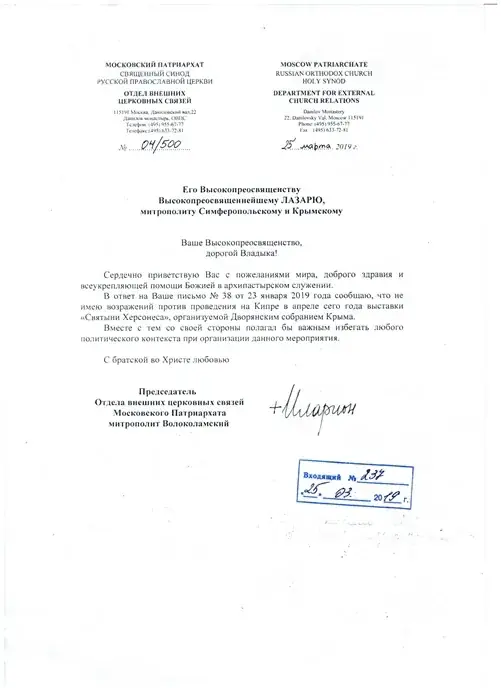
It is worth noting that the exhibition, planned for January 2019, was approved in March, moved to April and held in June 2019.
Here is a quote from the report of the Nobility Assembly of Crimea posted on its website: “As a result of a visit to the Republic of Cyprus in December 2018, an agreement was reached with the Church of Cyprus to hold in 2019 in the Republic of Cyprus a number of exhibitions about the holy places of the Crimean peninsula and to send tourists from the Republic of Cyprus to the Crimean peninsula along pilgrim routes”.
So much for the claim that the interest came first from Cypriot museum staff, parishioners and priests, as the leader of the Nobility Assembly would like to present it.
In the interview mentioned above, Ushakov insistently assures readers that the Crimean event in Cyprus “is purely cultural and educational”, that it is not propaganda and was organised only to share the cultural heritage of the peninsula with the island. Because the museum is a UNESCO World Heritage site and belongs to the whole world.
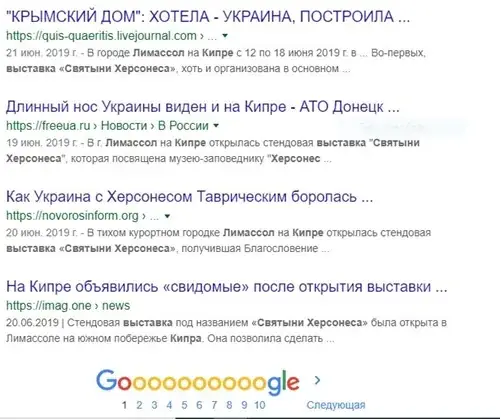
Andrei Ushakov also stressed that there is no connection between the project and “the actions of the security services or Putin”, or the Russian authorities. Try proving otherwise…
In this respect it is interesting to look at the chronology of the preparation of the “Crimea House in the EU” project.
On 8 May 2018 the 12th international festival “The Great Russian Word” was held in Yalta. NAC leader Andrei Ushakov gave a talk there on the advisability of creating a cultural centre, the “Crimea House in the European Union”, in Limassol (Republic of Cyprus) on the basis of the official representative office of the Russian Nobility Assembly.
In autumn 2018, from 31 October to 1 November, the 6th World Congress of Compatriots was held in Moscow under the slogan “Russia and compatriots: new challenges and new frontiers”. A NAC news release said that the Republic of Crimea was represented at the congress by Georgy Muradov, permanent representative of the Republic of Crimea to the President of Russia, NAC leader Andrei Ushakov and State Duma deputy Pavel Shperov. The same release said:
“Andrei Ushakov discussed with representatives of the Russian Foreign Ministry the prospects and details of creating a cultural centre, the ‘Crimea House in the European Union’, on the basis of the official representative office of the Russian Nobility Assembly in the Republic of Cyprus.” “The participants noted that the ‘Crimea House in the EU’ could become a reliable platform for pursuing Russia’s state policy in the EU countries and make a significant contribution to the recognition by the international community of the Republic of Crimea and the city of Sevastopol as full and legitimate subjects of the Russian Federation.”
The release does not say with whom exactly in the Russian Foreign Ministry the prospects and details of the “Crimea House in the EU” were discussed, but the discussion was apparently high-level.
On 24 November 2018 a general reporting and election meeting of NAC members was held in Crimea, at which Andrei Ushakov reported on the organisation’s activities over three years. The meeting considered proposals from NAC members to create a culture department and a department for cooperation with public organisations and state authorities. The proposed structure for cooperation with state authorities inside a public organisation looks more like the structure of some government department.
Two days after the NAC reporting and election meeting, Andrei Ushakov, the official representative of the RNA in Cyprus, flies to the island.
On 26 November 2018 he holds a working meeting with the Russian ambassador Stanislav Osadchiy at the Russian Embassy in Cyprus. “During the meeting the parties discussed the project to create a Cultural Centre of the Russian Nobility Assembly in the Republic of Cyprus and a plan of joint events for 2019 in the field of culture and art,” says a release on the NAC website.
After the meeting Andrei Ushakov, together with Russian embassy staff, visited the Russian cultural centre, where he held talks with its director Alina Radchenko.
“The talks concerned holding a number of landmark events under the auspices of the Russian Nobility Assembly in 2019-2020. Agreements were reached on holding a series of exhibitions, concerts and creative meetings at the Russian Cultural Centre.”
In December 2018, as a result of his visit to the Republic of Cyprus, Ushakov agreed with the Church of Cyprus to hold exhibitions “about the holy places of the Crimean peninsula” and to send tourists from Cyprus to the Crimean peninsula along pilgrim routes.
In honour of the 900th anniversary of the spiritual ties between Russia and Cyprus, the official representative office of the Russian Nobility Assembly in Cyprus also developed a pilgrim route, “Orthodox Shrines of Cyprus. From Byzantium to the Present Day”.
On 21 February 2019 Andrei Ushakov took part in the 1st Ushakov Forum. Among its co-organisers was the Imperial Orthodox Palestine Society (IOPS). “Delegates heard greetings from IOPS honorary member and Russian Foreign Minister Sergei Lavrov, from Sergei Naryshkin, director of the Foreign Intelligence Service and chairman of the Russian Historical Society, and from the Synodal Department of the Moscow Patriarchate for Cooperation with the Armed Forces.” The forum was addressed by co-chairman of the organising committee and IOPS chairman Sergei Stepashin, former director of the FSB.
It was exactly at this time that correspondence with the hierarchs of the Russian Orthodox Church about approving the exhibition in Cyprus was under way.
In the letters the planned exhibition was still called “Shrines of Crimea”; it was finally renamed only closer to summer.
So it can be said that the initiative to create a permanent venue, the “Crimea House in the EU”, for cultural, information and business events came from the highest circles of the Russian government. The project was developed for more than a year but was only partly carried out.
Cyprus was not chosen by chance either. Everything was taken into account: the local population’s friendly attitude towards Russia, the common religion, the national character of Cypriots, the large number of Russian speakers living in Cyprus, the loyalty of the local authorities towards Russia and much more. It is hard to find a better place in Europe for a Russian-Crimean ideological intervention.
After the Crimean “permanent venue in the EU” was set up and the exhibition and first meeting of the “Club of Friends” were held in Cyprus, the work is being continued by another “player”, the Imperial Orthodox Palestine Society (IOPS).
This society opened a representative office in Greece in 2016, but, as the BBC Russian Service writes, in 2018 Athens “suspected the IOPS of trying to influence Greece’s internal affairs and stopped issuing visas to Russian priests”.
At the same time Greece expelled two Russian diplomats: “According to Greek media, the Greek authorities considered them involved in interfering in the country’s internal affairs, namely in trying to derail the agreement on a new name for neighbouring Macedonia.” One of the expelled diplomats was Alexei Popov, deputy to Simos Panagiotidis, the Tashkent-born head of the IOPS Greek branch.
The IOPS is headed by Sergei Stepashin, former director of the counter-intelligence service, former head of the Federal Security Service and former prime minister of Russia, who recently visited Cyprus and agreed with the Cypriot authorities to resume the “Russia-Cyprus-Israel” pilgrim routes.
So it is too early to celebrate. Despite the actual failure of the first stage of the operation, it continues. All the old players are still in place, and bringing in such a heavy figure as Stepashin most likely means preparation for its next, more successful stage.
First published by Cyprus Daily News.