The FSB’s oasis in the European Union
Updated: 2 days ago

Russian embassies in most countries stand out from other diplomatic missions because of their inexplicably bloated staff. They look more like military garrisons than embassies.
It was the same in Soviet times, when the main job of Soviet embassies was not diplomacy but espionage: building networks of agents of influence, recruiting agents and carrying out sabotage. In this respect nothing has changed in modern Russia.
After Russia launched its full-scale aggression against Ukraine in 2022, European capitals declared hundreds of Russian “diplomats” known to be engaged in espionage persona non grata. The mass expulsions sharply cut Moscow’s ability to run covert operations in the EU. Cyprus, however, was left out of this.
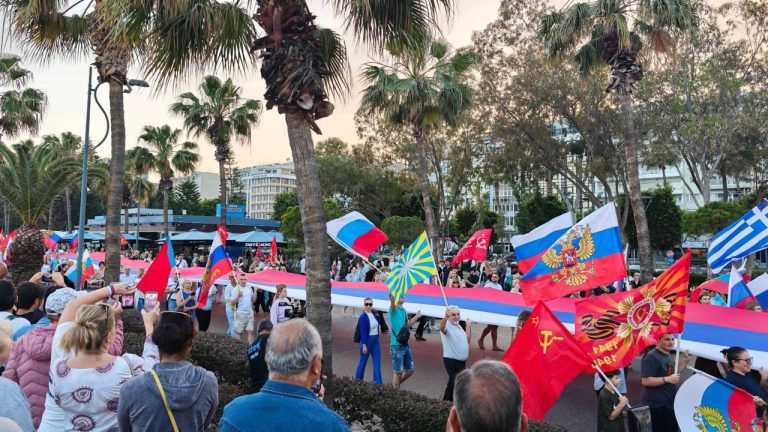
Since the invasion of Ukraine, the authorities of the Republic of Cyprus have not expelled a single Russian diplomat. On the contrary, the staff of the Russian Embassy in Nicosia has grown, mostly through additional technical personnel. According to experts at the Center for Investigation and Research (CIR), the mission is controlled by FSB Lieutenant General Murat Zyazikov, who operates in Cyprus under the cover of Russian ambassador. It officially employs 41 people, and at least 80% of them are career officers of the Russian intelligence services: the FSB, the SVR and the GRU. That does not count the technical staff and the many service employees, who are also either intelligence officers or agents recruited by them. Cyprus has a population of only about one million. Meanwhile the Cypriot embassy in Russia, a country of 140 million, has just five diplomats, including the ambassador.
The gap exists because the two countries’ missions do different jobs. Cypriot diplomats really do work on foreign policy. Russian diplomats, as in the Soviet era, are mostly intelligence officers under cover. Their real work is espionage, sabotage, disinformation, recruitment, influence operations, destabilizing the host country and controlling assets.
None of this is new; the same was happening in Soviet times. In his 1974 book KGB: The Secret Work of Soviet Secret Agents, John Barron wrote:
“Because the KGB fills so many Soviet embassies with its own officers, their staffs are swollen to absurd size, far beyond the normal needs of diplomatic work. In 1971 there were five Mexicans with diplomatic immunity in Moscow and sixty Soviet officials with diplomatic immunity in Mexico City; 108 Americans in Moscow and 189 Soviet officials with diplomatic immunity in Washington. That same year there were two Lebanese in Moscow and thirty-one Russians in Beirut; four Danes in Moscow and thirty-one Russians in Copenhagen; five Norwegians in Moscow and twenty-five Russians in Oslo; twenty West Germans in Moscow and fifty Russians in Bonn. In all, 809 diplomats from eighty-seven non-communist countries were accredited in Moscow, while 1,769 Soviet diplomats were accredited in those same countries.
The same predominance of KGB personnel can be seen in the Soviet delegation to the UN and among the 207 Soviet nationals working in the UN Secretariat in New York. A fascinating top-secret textbook, obtained by Western intelligence from Higher Intelligence School No. 101 near Moscow, stresses the value of the United Nations as a secret base. The KGB textbook, titled Practical Recruitment of Americans in the United States and Third World Countries, states: ‘In the United States, in addition to ordinary cover, we use international organizations. The most important of these is the UN and its specialized agencies.’”
Moscow still uses this practice today.
In Cyprus a special role is played by a representative of the FSB’s 5th Service, the Department of Operational Information and International Relations, set up in the early 2000s during the reform of the FSB. Officially it is responsible for “liaison with foreign intelligence services.” In practice the 5th Service is a tool of political warfare and expansion, built to keep control over the post-Soviet space and to undermine the sovereignty of neighboring countries.
Before the invasion of Ukraine, it was officers of the FSB’s 5th Service who handled Kremlin-friendly politicians, organizations and media inside Ukraine. This unit reported that a military invasion would enjoy broad support among Ukrainians. The intelligence was wrong, yet the Russian leadership relied on it when deciding to invade, and it became one of the reasons the Kremlin’s blitzkrieg failed so badly and the war dragged on.
Today officers of this service are active not only in the former Soviet republics but also in EU countries, Cyprus included.
The key executor of the will of the FSB resident in Cyprus, who is also Russia’s ambassador to the island, is the number two at the Russian mission: 5th Service officer Erkin Topoev, who works under diplomatic cover as counsellor at the Russian Embassy in Nicosia. Topoev coordinates the Russian agent network on the island. Through him General Zyazikov receives operational information, gives orders and oversees the recruitment of new agents.
Erkin Topoev was born in Moscow in 1983 into the family of Kyrgyz General Esen Topoev, a former defense minister of Kyrgyzstan with close ties to Moscow. Erkin graduated from the Moscow Suvorov Military School in 2000, received Russian citizenship in 2001, then graduated from the FSB Academy and was seconded to the Foreign Ministry, where he began his intelligence career. He has worked under diplomatic cover in France, Greece and Kazakhstan.
A few months ago Topoev arrived in Cyprus with a senior diplomatic rank. He is responsible for recruiting and running particularly valuable agents. He also oversees the Cypriot cluster of projects in Kyrgyzstan that the Kremlin carries out through Russian businesses in Cyprus. Notably, in the first months of this year, just as Topoev arrived in Cyprus, a number of Russian businessmen and bankers with Cypriot citizenship began investing heavily in development projects in Bishkek, building hotels on Lake Issyk-Kul and opening banks in Kyrgyzstan aimed at corporate clients.
This sudden investment fever among “Russian Cypriots” in Kyrgyzstan is clearly linked to the arrival in Nicosia of Erkin Topoev, who coordinates the Kremlin’s operations in Kyrgyzstan through Russian business in Cyprus.
Cyprus is not prepared to counter Moscow’s hybrid threats, which makes it an ideal base for Russian intelligence and the agent networks it has built. Russia long ago turned the island into its intelligence hub for espionage, sabotage and disinformation operations against Europe. From here it coordinates interference not only in Cyprus’s own affairs but also in other EU countries.
Despite sanctions, some of the Kremlin oligarchs’ assets are still hidden in Cypriot trusts, financial structures and schemes dressed up as legitimate business. Cyprus is a gateway through which the Kremlin gets around sanctions and keeps pumping billions to finance not only the war in Ukraine but also hybrid operations against the entire democratic West.