Russia’s Hybrid Influence in Cyprus: How Moscow’s Intelligence Networks Are Attempting to Undermine European Solidarity
Updated: Oct 5

With the EU summit under way in Nicosia and Ayia Napa, Russian entities stepped up their disinformation and leaned harder on the local political forces they control. This goes beyond propaganda: it is a systematic effort to destabilise the country.
Narratives designed to divide
The Russian Centre for Science and Culture and the Cypriot branch of the International Movement of Russophiles are actively pushing two narratives meant to undermine European solidarity on the island.
The first is the “genocide in Donbas”, a phrase used to cast Russia as a victim defending civilians.
The facts say otherwise. Russian forces have systematically attacked Ukraine’s civilian infrastructure. The mass killings in Bucha have been confirmed by satellite imagery, forensic examinations and UN investigations.
Mariupol has become a symbol of the destruction wrought by the Russian army. Losses on this scale – hundreds of thousands killed and wounded – show that this is not defence but barbaric aggression.
The second narrative is “Russia’s war with NATO”, which portrays Ukraine as a Western proxy.
In reality, NATO is not fighting on Ukrainian soil, and the war began with Russia’s invasion on 24 February 2022. These claims are part of a disinformation campaign to change how the conflict is perceived.
Cyprus cannot stay neutral
Cyprus supports sanctions against Russia not under pressure, but out of its own experience and its commitment to European values.
Since the Turkish invasion of 1974, the country has lived with the consequences of occupation and knows exactly what a violation of sovereignty means.
That is why neutrality in the face of aggression against Ukraine is impossible: it would run against Cyprus’s fundamental national interests and the principle of European solidarity.
From propaganda to politics: local networks of influence
Russian influence in Cyprus has long reached beyond the information space and rests on local political and social structures.
Alina Radchenko and Mikis Filaniotis, who operate where “humanitarian” work meets political influence, are regularly in the spotlight. Under the guise of aid, channels of support for Russian occupation forces in the occupied territories of Ukraine are being set up.
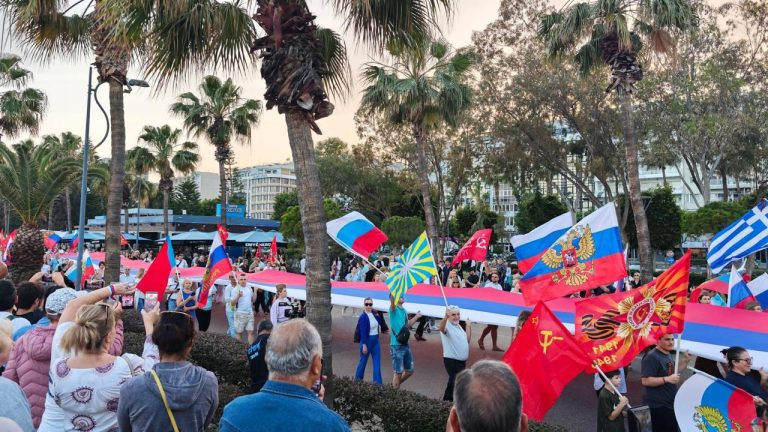
At the same time, the Hunters, Agronomos and Elpis parties – all controlled by Russian structures – are being used to destabilise Cyprus. They carry Kremlin narratives into Cypriot politics and voice support for Putin’s regime at pro-Russian rallies.
Of particular note is the involvement of members of the Agronomos party, led by Andreas Christofi, in farmers’ protests that blocked the motorway near the Rizoelia junction. These actions directly hampered the movement of EU summit participants.

Members of the Hunters’ party also took part in the protest.

Andreas Christofi has long been known as a conduit for Russian influence in Cyprus. Since the start of Russia’s full-scale war against Ukraine, he has taken part in pro-Russian rallies and events supporting the aggression.

Formally, such protests look like expressions of socio-economic grievance. But their timing relative to political events and the involvement of groups pushing a pro-Russian agenda point to possible outside influence.
Such actions clearly fit a broader destabilisation strategy typical of the Russian intelligence services, which have long used social protest as a tool to apply pressure and sow division.
Money and sanctions
Funding is a key part of this system.
The Russian Centre for Science and Culture operates with the support of Rossotrudnichestvo, which raises serious questions under the EU sanctions regime.
The money flows are not only a tool of influence but potentially a breach of European law.
9 May: the battle over historical memory
Symbolic dates, Victory Day above all, play a major role in Russia’s influence operations abroad.
The “Immortal Regiment” marches and related events are presented as acts of remembrance, but in practice they are political actions synchronised with Moscow’s official line.
It needs to be said plainly: 9 May is not a day of victory for today’s Russia.
It is a day to remember the millions of people of many nationalities who died in the Second World War. The Kremlin is trying to monopolise that memory and use it to justify its aggression against Ukraine and the entire free world.
The date is better understood as a day of mourning for the victims of the war and of Stalin’s repressions – a day to reflect on tragedy, not to celebrate political triumph.
Conclusion
The situation in Cyprus shows that Russian influence is not just propaganda. It is a comprehensive strategy that combines disinformation, the use of cultural and social structures, reliance on local political forces, the exploitation of social protest and the manipulation of historical memory.
The answer to these challenges is not confrontation but a clear understanding of one’s own interests.
Cyprus’s interests demand that its statehood and reputation be protected from Russian influence and that the country’s European future be strengthened.