“Russian House” in Nicosia: an incubator of Russian spies in Cyprus
Updated: 2 days ago

For Soviet and Russian security services, recruitment of foreign nationals was the most important method of work. This practice, which has its roots in the early years of the Bolshevik dictatorship in Russia, remains unchanged today.
The recruited agents form extensive networks that become a powerful tool of Moscow’s espionage and political influence.
Their tasks include the collection of secret political, economic and military information, as well as the promotion of Russian interests in various spheres. Such agents infiltrate political circles, business communities, religious organizations, sports associations and social movements, allowing them to influence political processes, manipulate public opinion, destabilize the country and promote Moscow's interests at various levels.
By managing these networks skillfully, the Russian intelligence services achieve their goals without visible interference, creating the illusion that the recruits act on their own.
In Cyprus, Russian special services (FSB, GRU, SVR, Rossotrudnichestvo) have long and successfully recruited businessmen, politicians, police officers, journalists, diplomats, religious figures, students, public figures and even leaders of organized crime through various channels. The latter serve as a private army for the Russian security services and businessmen associated with them, providing them with force support and security services.
Russia has created and finances numerous front organizations on the island masquerading as public, cultural, sports and educational institutions.
Legal structures act as a cover for espionage, influencing local elites, manipulating Cypriot public opinion and destabilizing the situation in the country. All this has allowed Moscow to achieve impressive results in bringing the Republic of Cyprus into the orbit of its influence.
This success of the Russian services is the result of long, systematic and purposeful work carried out for more than sixty years, since Cyprus became independent, and even long before that. Moscow has always understood how valuable foreign agents are, so it recruited them in advance, long before they were needed. It recruited at every opportunity, whatever the geopolitical circumstances of the day, and so built up a reserve of “sleeper” agents ready to be activated at the right moment.
In his book “KGB Today,” John Barron wrote about the largest intelligence operations of the NKVD and the KGB: “None of these operations would have succeeded if agents had been recruited only when they were needed... Spotting, recruiting, gradually inserting agents and advancing them through legal service is the most important of the tasks facing the staff of the First Chief Directorate.”
Dmitry Khmelnitsky, a historian who studies the Soviet and Russian intelligence services, explains why this strategy works: “For Moscow, training new generations of agents of influence and spies from among foreign young people is a traditional, long-running program. Who knows what positions, in which countries and in which organizations today’s schoolboy or student will hold in ten years? The earlier you buy them, the better.”
After the collapse of the USSR, the KGB and later the FSB recruited foreign young people mainly among Russian-speaking emigrants, tourists and foreign students who came to the country on exchange programs or simply to study.
After Russia launched its full-scale war against Ukraine in February 2022, the situation changed. Tourism dried up, there are few students, and almost none from EU countries. Direct flights to Europe were cut. The Russian services quickly adapted: they revived a program dating back to Soviet times to bring foreign students to Russian universities. The Kremlin has greatly expanded it and is spending huge sums to recruit a new generation of agents.
In August 2022, Deputy Minister of Economic Development Dmitry Volvach announced a system of grants for talented foreign students studying in Russia.
In February 2022 the quota for foreign students was raised: to 23,000 places in 2022 and 30,000 in 2023. This shows how much importance the Russian intelligence services attach to recruiting foreigners.
In Cyprus, as in other countries, the key structure implementing the program of attraction, selection and training of foreign citizens to study in Russia is the Russian Center for Science and Culture (RCSC) in Nicosia. Under the leadership of its director, Alina Radchenko, the center actively promotes educational programs, which at first glance look quite innocent. On closer examination, it becomes clear that they are part of the strategic plan of the Russian security services to form a new generation of agents of influence. For these purposes, social networks are actively used, including Facebook, which is banned in Russia, where the RCSC regularly publishes announcements about the selection of applicants to Russian universities. These posts emphasize "free tuition," scholarships and other benefits, making them extremely attractive to young citizens of Cyprus and other countries.
Such recruitment centers of the Russian intelligence services, operating under the guise of scientific, cultural and educational institutions, play a crucial role in the global system of influence the Kremlin has built outside Russia.
Here are a few examples of how a new generation of agents is being formed.
In September 2024, on the pages of several Russian Houses (for example, in Nicosia and Dushanbe) an announcement appeared about the online Olympiad "Themis" for citizens of foreign countries. The Olympiad is organized by the Russian State University of Justice - "The winners and prize-winners of the Olympiad are guaranteed admission to the University within the quota established by the Government of the Russian Federation".
This news has a telling subtext. Russia in 2024 is a state without the rule of law: no justice, few civil liberties and wild, anti-democratic laws. Going to today’s Russia to study law makes as much sense as going to North Korea or Belarus, and serves the same purposes, which have nothing to do with education.
A sane foreigner who goes to Russia today to study law is either completely ignorant or an agent already recruited by the Russian services.
In fact, taking part in the olympiad is itself a sign of readiness to be recruited. Interestingly, registration dates differ from country to country: in Cyprus from September 23 to November 5, in Tajikistan from November 5 to November 26. This points to systematic work with specific countries rather than a single universal program.
At the same time as the Themis announcement, the Russian House page published an announcement about the extension of applications for the III International Media Award "Honest Look", for which "more than 300 applications from 50 countries have already been registered".
It is a contest open to everyone, including foreigners ready to become Moscow’s propagandists, as the list of nominations and prizes makes more than clear:
"Applications are accepted in all languages on the official website of the award honest-view.press from individual journalists, editorial teams and bloggers.
Nominations of the Honest View award:
Grand Prix, the main prize of the Honest View award;
Best material on social and humanitarian issues;
Best material on international cultural partnership with Russia;
Best material in the genre of opinion journalism and documentary;
Best material about Russia by young journalists;
Best material in the partner nomination from RT.
We would like to remind you that this year there is a new nomination for young journalists aged 18 to 25. The finalists will visit Moscow to take part in a two-day Media School held on the eve of the awards ceremony. Don’t miss the chance to win a cash prize and attend the ceremony in the Russian capital.”
Here you can see the selection and training of Putin’s agents of influence at work.
Another example. On September 27, the Russian House in Nicosia published an announcement: "We invite you to take part in the annual competition for the title of laureate of the International Environmental Prize "EcoWorld-2024". The founder of the Prize is the public organization "Russian Academy of Natural Sciences". The Prize is awarded for outstanding achievements in environmental protection and environmental safety, as well as in other environmental activities. The selection of the contest participants is based on the submitted applications and documents confirming the implementation of the submitted projects, programs and actions. The deadline for submitting applications for the contest is December 1, 2024".
The Russian Academy of Natural Sciences (RANS), like its German offshoot, the European Academy of Natural Sciences (EANS), is a pseudo-public organization with close ties to the security services. It was set up in 1990 and for many years has been handing out, or selling, home-made titles and a host of amusing orders of its own invention.
Such “academies,” which have nothing to do with science, were invented in Russia in the 1990s, and in recent years they seem to have been given a new lease of life. RANS, at any rate, noisily imitates scientific activity. An invitation to compete for something entirely vague, with many nominations, including, for example, “environmental and patriotic activities,” is in reality simply an invitation to enter into mutually beneficial contact with the Moscow authorities. After that, competent specialists will decide which applicants are of interest and which are not.
All these efforts of the Russian Center for Science and Culture (RCSC) in Nicosia are aimed at renewing agent networks with Cypriot young people, because the pool of earlier generations of agents, recruited in Soviet times and in the 1990s, has shrunk noticeably and no longer meets today’s needs.
It would be wrong to think that the RCSC began this work only after 2022. On the contrary, attracting young Cypriots to study in Russia has always been one of the center’s priorities, and it has achieved impressive results.
To better understand the effectiveness of the RCSC's work in recruiting new agents, it is best to look at one of its protégés, Vladimir Gorin, a rising star among the Russian services’ agents of influence in Cyprus. A special role in his "education" was played by two officers of the Russian Foreign Intelligence Service (SVR): Denis Borodich, acting under the guise of an advisor to the Russian Embassy, and Igor Melnik, acting under the guise of a specialist of the Russian Center for Science and Culture (RCSC) in Nicosia, responsible for higher education programs in Russia.

Gorin appeared at the RCSC in Nicosia in 2017, right after moving from Greece, and began attending classes at the Pioneer educational center at the RCSC. His EU citizenship and command of several languages made him a particularly valuable asset for his handlers from the Russian intelligence services. In 2018 he became a robotics teacher at the Pioneer center, and in the same year an activist of the Green Party, which is represented in the Cypriot parliament. Membership of the environmentalist party gave Gorin access to political and public platforms, to various government departments and to international conferences where he represented the party. This status let his handlers use Gorin to gather information and make contacts with diplomats and politicians from various countries.
On October 5-7, 2022, the 9th United Nations Economic Commission for Europe (UNECE) European Environment Ministers' Conference "Environment for Europe" was held in Nicosia under the motto "Transforming the Planet." Gorin spoke at the conference as a volunteer and liaison officer recommended by the Green Party. However, in the opinion of some conference participants with experience of working at such events, his actions went far beyond his authority and were more akin to the behavior of a spy seeking confidential information. Gorin showed an unusual interest in discussions and documents of interest to Denis Borodich, the head of the Russian delegation.
Gorin is a member of numerous pro-Russian organizations, including the Youth Club of Russian Compatriots and the coordinator of the "Volunteers of Victory" movement in Cyprus. Gorin has the status of "ambassador of the Russian language in the world". For this purpose Gorin studied in Moscow at the Pushkin Institute under a special program to spread Kremlin propaganda.
In the spring of 2024, Gorin was among the guests of the World Youth Festival in Sochi, where, according to TASS, he applied for Russian citizenship.
Gorin takes part in, and often hosts, all the propaganda events organized by the Russian Embassy and the RCSC in Cyprus. At these events he has repeatedly made anti-Western statements in the spirit of Russian state propaganda.
Here is one of many examples.
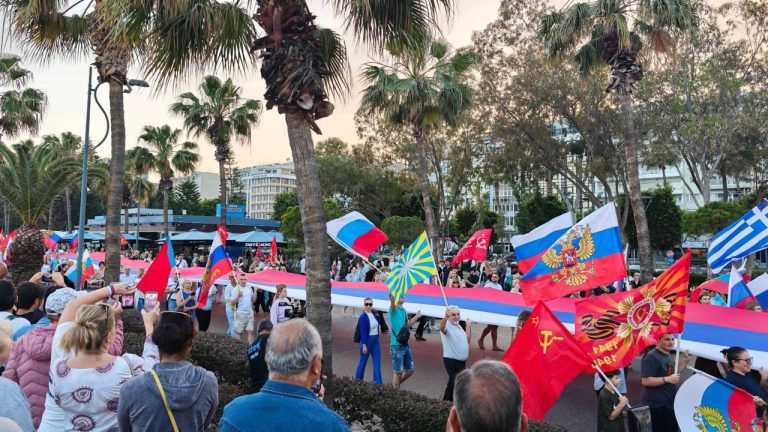
On July 8, 2023, a pro-Russian propaganda event was held in Nicosia: a march and rally “in defense of traditional family values,” organized by the pro-Russian party Active Citizens – United Cypriot Hunters and the Coordination Council of Russian Compatriots of Cyprus (CCRC).
Vladimir Gorin, a protégé of the RCSC, told the crowd: “Let us finally, as a nation, wake up and realize that the country is sliding straight into the abyss and losing its sovereignty. While we broadly share the values of the West, we must not blindly give up the soul of our country for imaginary support. We must fight and understand what is right and what is wrong according to our religion and history. Russia is the first country in the world to fight as a state to preserve traditional values based on the country’s main religion, Orthodox Christianity. Russia has protected the rights of the family in law; it is the only country fighting Satanism so that every country in the world can have these rights.”
This nonsense needs no comment. But it is worth asking why, and by whom, it is being broadcast publicly in the capital of a European state and EU member.
Love for Russia did not prevent Vladimir Gorin from running as a candidate of the Green Party in the municipal elections in one of the districts of Nicosia in May this year. The leadership of the Green Party is well aware of his close ties with Russian state structures and his contacts with the Russian security services, but prefers to turn a blind eye. This approach is not surprising because, as André Thierryard aptly put it, "the Greens are unripe Reds". Environmental parties, occupying the left flank of the political spectrum, traditionally neighbor communists and radical progressives. This explains their ideological affinity and sympathy for Russia. In this context, Gorin's choice of the party of which he became a member is not accidental.
On its Facebook page, the CCRC enthusiastically announced Gorin's candidacy, describing his many strengths and talents, and naming the candidate's main goals with the utmost candor: "Vladimiros recently returned from the World Youth Festival in Sochi, where he gained many new ideas and skills. He is inspired by this experience and wants to create projects and initiatives that will help our municipality. His proposals include developing educational programs, supporting youth startups and innovative projects, as well as organizing cultural and sporting events.
In addition, Vladimiros is an ambassador of the Russian language in the world, representing Cyprus and Greece. He is committed to promoting Russian culture and language, which helps strengthen international ties and enrich our society culturally. He understands the importance of strong relations between Cyprus and Russia and will fight to strengthen them.”
What ideas Vladimir picked up at the Kremlin festival in Sochi, and what skills he gained from the Russian services that supervised it, is obvious: the ideas and skills of an agent of the Russian intelligence services.
In November 2024 Gorin solemnly announced that he was elected to the European "youth parliament" of Cyprus as a member of the committee on education and culture. Who elected him remains unclear.
The Youth Parliament has operated in Cyprus since 2004. Its work mirrors that of the real parliament, which makes it an incubator of future Cypriot politicians.
Membership in the youth parliament opened up even more opportunities for Gorin and his SVR handlers to penetrate the political establishment of the country. He has already taken part in events attended by the country's President Nikos Christodoulidis and the Speaker of the House of Representatives of the Republic, Annita Dimitriou.

Gorin with President Christodoulidis
In effect, Gorin is pursuing two careers at once: one in the Russian intelligence services and one in Cypriot politics. The Russian services are cultivating him into a rare type of agent of influence, and one extremely valuable to Moscow.
It should also be understood that there is often no line at all between an agent of influence and a spy.
Kirill Khenkin, an excellent expert on the foreign operations of the NKVD and the KGB, wrote in his book “The Russians Have Come”: “Yes, the line between direct Soviet espionage, the work of paid agents of influence and friendly favors to comrades from embassies was very blurred. It never existed. Nor does it now.” Khenkin’s “now” refers to the 1980s, but it applies equally to the first quarter of the twenty-first century.
Boris Demash, especially for Cyprus Daily News