Pontic Greeks: expendable material for Russian intelligence
Updated: 2 days ago

In late April, European media reported that a 59-year-old Georgian-born man with Greek citizenship had been arrested in the Greek city of Alexandroupolis on charges of spying for Russian military intelligence, the GRU. According to investigators, he was recruited by another Greek citizen, aged 52 and also born in Georgia. Both are Pontic Greeks who moved from Georgia to Greece as soon as this became possible after the collapse of the USSR.
Cypriot media, citing police sources, reported that the 52-year-old had lived in Cyprus from 2008 to 2011 and was known as Vikenti Ts.
His trail went cold until March last year, when he was arrested in Lithuania. It was also reported that in mid-March the Lithuanian authorities asked Cyprus for information on Vikenti Ts., who is now in custody in Lithuania on a number of criminal charges.
Vikenti is a member of an international organized crime group and was recruited by the GRU to draw third parties into spying for Russia.
He took part in a Russian military intelligence sabotage operation: an arson attack on a facility in a Balkan country. He was also involved in an attempt to kill a former Russian agent who had defected to the West and was hiding in the Balkans. In addition, Vikenti took part in planning the murder of a Russian dissident, reportedly in Lithuania.
Cyprus Daily News has identified the Russian military intelligence agent detained by the Lithuanian authorities as Vikenti Vladimirovich Tsopozov, a citizen of Russia and Greece.
Tsopozov was born on May 18, 1973, in the village of Guniakala in Georgia’s Tsalka district, an area with a large Pontic Greek community.

According to information obtained by our editorial team, Tsopozov did live in Limassol, Cyprus, from 2008 to 2011. On December 24, 2008, he was issued Russian passport No. 0514128859 at the Russian Embassy in Nicosia.
When and where Tsopozov was recruited by Russian military intelligence, in Russia or in Cyprus, is not yet clear.
Since the early 2000s Tsopozov has reportedly lived in Russia, in Zheleznodorozhny near Moscow and in Ivanovo. In August 2018 he obtained a Russian internal passport in Mordovia, where he was living at the time.
At various times he also lived in the village of Bergamak in the Omsk region and in the town of Yessentuki. In all these places Tsopozov worked in construction, apart from a short spell farming in the Omsk region.
According to leaked data, his credit history shows that Tsopozov was constantly in debt and received money transfers from Greece every month. His name appears in the Russian “Anti-Creditors” database.
After Russia’s full-scale invasion of Ukraine in February 2022 and the expulsion of hundreds of Russian intelligence officers working under diplomatic cover in Western countries, the Russian intelligence services, including the GRU (the Main Directorate of the General Staff), radically changed how they operate abroad. In the past, Moscow sent highly qualified officers abroad and placed them under deep cover, after years of training and at great expense. Now the Russian services recruit poorly trained but numerous and cheap agents en masse from among emigrants from the former Soviet Union and foreigners looking for easy money. These people are treated as expendable: they carry out sabotage, surveillance and information gathering, stir up riots and take part in propaganda events. If they are caught, the Russian authorities make no effort to rescue or exchange them.
Pontic Greeks, most of whom support Russia, Putin and the war in Ukraine, hold a special place in this strategy. In Cyprus the GRU actively uses Pontians in its intelligence, sabotage, psychological, disinformation and propaganda operations.
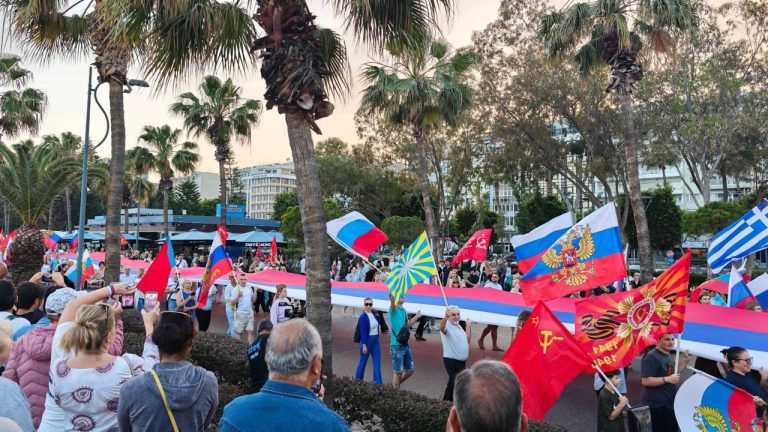
Pontic Greeks serve as couriers, delivering messages and materials. They gather intelligence on local political and economic developments and take part in pro-Russian events staged to promote Kremlin propaganda. These events draw crowds of emigrants loyal to Russia, among whom Pontians are prominent. Many of them cooperate voluntarily, out of conviction.
Photos from a rally in support of Russia and the war in Ukraine held in Paphos on April 3, 2022. Most of the participants were Pontic Greeks. The rally was organized by the Russian Embassy, the Russian Cultural Center, the Coordinating Council of Russian Compatriots and the Society of Pontic Greeks of Cyprus.
The mass involvement of Pontic Greeks in these activities allows the GRU and other Russian services to create the appearance of broad support for Russian policy in Europe.
The case of Vikenti Tsopozov sheds light on the methods and new tactics of Russian intelligence. We are following it and will keep our readers informed.