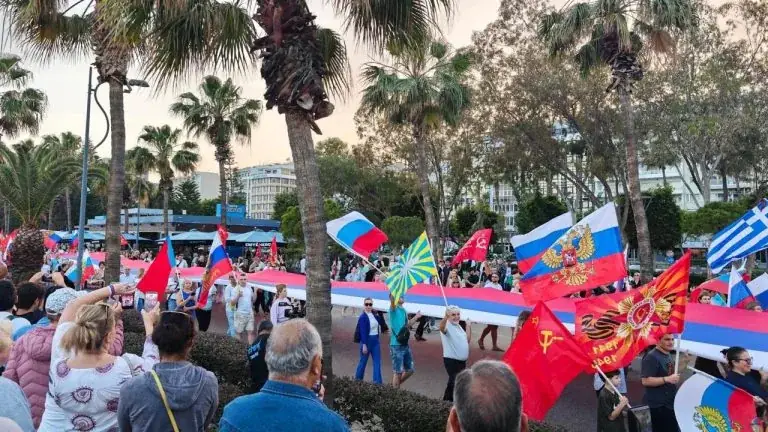
‘The Immortal Regiment’ is the name of a movement conceived in 2011 in Tomsk by several journalists, and also the name given to the events that take place during the annual demonstrations on 9 May, when people take to the streets carrying portraits of their relatives who died in the Second World War or simply took part in it. This grassroots movement very quickly turned into a massive, state-sponsored patriotic event with a network of coordinators across the globe.
In 2014, the organisers officially registered the Interregional Historical and Patriotic Movement ‘Immortal Regiment’, and in 2015 the ‘Immortal Regiment’ march took place on Red Square for the first time following the ‘Victory Day parade’.
The ‘Immortal Regiment’ is perhaps the only initiative by Putin’s propagandists that appeals to many sections of the Russian population and émigrés, including those who are sceptical of the regime, as virtually every family had relatives who died during the war. Not everyone realises, however, that this event is less about commemorating the dead and more about the cynical glorification of Stalin’s victories and conquests during the Second World War. The culmination of this state cynicism came in 2016 when Vyacheslav Nikonov, head of the ‘Russkiy Mir’ Foundation, appeared in the march carrying a portrait of his grandfather, Vyacheslav Molotov, Stalin’s foreign minister and one of the principal architects of the Second World War.
In fact, there are three movements bearing virtually the same name. In September 2015, the all-Russian public civic-patriotic movement ‘Immortal Regiment of Russia’ was registered. The initiators of its creation were the Regional Public Organisation ‘Immortal Regiment – Moscow’, the All-Russian People’s Front and the Public Chamber of the Russian Federation. The organisation’s co-chairs are MP Nikolai Zemtsov, actor Vasily Lanovoy and the originator of the idea, Gennady Ivanov.
‘The Immortal Regiment of Russia’ is now a fully state-run organisation, the emergence of which was met with disapproval by the organisers of the first ‘Immortal Regiment’ – its website stated that this organisation had been created through ‘bureaucratic methods’. ‘The Immortal Regiment of Russia uses different symbols from the people’s Regiment. The symbol of the original movement is the little crane. The symbol of the Immortal Regiment of Russia is St George the Victorious,’ as noted in a text posted on the ‘Immortal Regiment’ movement’s portal.
There is another organisation: the International Immortal Regiment. It is listed as a partner of the ‘Immortal Regiment of Russia’. Its page lists 101 countries worldwide where the movement has coordinators and annual marches are held. This list coincides with that of the Co-ordinating Councils of Russian Compatriots. It appears that organising marches is one of the responsibilities of Rossotrudnichestvo’s representative offices and its agents around the world. For Moscow, the regular holding of ‘Immortal Regiments’ plays a particularly important role against the backdrop of a general reduction in the scope for patriotic manoeuvres abroad. All the more so given that victory in the ‘Great Patriotic War’ is a key element of Putin’s entire patriotic propaganda campaign. Consequently, the role of the propaganda agents organising the marches is significant.
The role of general coordinator of the International Movement is held by the Russian businessman Mher Avetisyan, a figure who is most likely merely a figurehead.
The network of ‘Immortal Regiment’ activists around the world is undoubtedly very extensive. For example, in Germany in 2024, ‘Immortal Regiment’ marches took place in Berlin, Frankfurt am Main, Hürth, Augsburg, Hamburg, Cologne and Kiel, attracting several hundred people each.
Compatriot associations· Russia and international
The ‘Immortal Regiment’
How the Immortal Regiment, started in Tomsk in 2011 by a few journalists, became a mass state-run propaganda event at home and abroad.
Spotted an error or have more information about this organisation? Write to us at [email protected]